TCB Metal Works, Racine, Wisconsin · tcbmetalworks.com/free-training/industrial-enamel-spray/ · November 24, 2026
This is how we mix and spray Sherwin-Williams Industrial Enamel on steel in our shop with an HVLP gun. It is written for a new painter, and it is short enough to read at the booth.
Every number on this page is marked with where it comes from. SW data sheet means it is printed on Sherwin-Williams’ own product data sheet, solvents guide or safety data sheet. Harbor Freight manual means it is from the owner’s manual of the spray gun we use. TCB shop practice means it is how we do it, and Sherwin-Williams does not publish it. Where the two differ, we say so.
The Shop Card
The whole job on one table. Print this page and the table is what you hang by the booth. Every line is explained further down.
| Step | What to do | From |
|---|---|---|
| Product | Sherwin-Williams Industrial Enamel, B54 series. One-part alkyd, no hardener. | SW data sheet |
| Conditions | 40 to 120°F air, steel and paint. Steel at least 5°F above dew point. Humidity 85% or less. | SW data sheet |
| Prep | Degrease (SSPC-SP1), then at least hand-tool clean (SSPC-SP2). Blast (SSPC-SP6) is better. Prime bare steel within 8 hours. | SW data sheet |
| Primer | Kem Bond HS or Kem Kromik on steel. DTM Wash Primer on galvanized or aluminum. | SW data sheet |
| Mix | Tinted paint: 5 minutes on the shaker. Before spraying: slow power stir until even. | SW data sheet |
| Thin | About 10% xylene for our HVLP guns: 3.2 oz per quart, 12.8 oz per gallon. SW says no thinning. Never acetone. | TCB shop practice |
| Gun | Purple Harbor Freight 20 oz HVLP, 1.4 mm tip. Set air at the gun with the trigger pulled, never over the gun’s max (45 psi on items 62381 and 56982). Strain the paint, fill the cup 3/4, test on scrap. Hold it 6 to 9 in away. | Harbor Freight manual |
| Spray | Stripe welds, edges and corners first. 50% overlap. Two coats. | SW data sheet |
| Film | 1.9 to 3.9 dry mils per coat. | SW data sheet |
| Recoat | 8 hours at 77°F, 12 hours at 50°F. | SW data sheet |
| Rags | Into a sealed, water-filled metal can. They can catch fire on their own. | SW data sheet |
What You Are Spraying
Industrial Enamel is Sherwin-Williams’ all-purpose gloss enamel for steel: railings, frames, machinery, structural steel and equipment. The product number on the label starts with B54. The current sheet calls it Pro Industrial Industrial Enamel, B54-1100 series. The older sheet is the B54-100 series. The application data on both is the same. SW data sheet
- It is a medium oil alkyd. It is one part. There is no hardener and no catalyst, and nothing goes in it except, in our shop, a little thinner.
- It is 43% solids by volume. That means less than half of what you spray stays on the part. The rest is solvent that leaves as it dries, which is why wet film and dry film are different numbers.
- Its flash point is 101°F. The vapor can be lit by a spark or flame above that temperature.
- Shelf life is 36 months unopened.
Safety First
Sherwin-Williams’ safety data sheet for this enamel carries the word Danger. In its own words, it is a flammable liquid and vapor, may be fatal if swallowed and enters airways, may cause an allergic skin reaction, may cause drowsiness or dizziness, may cause cancer, and may damage fertility or the unborn child. SW safety data sheet
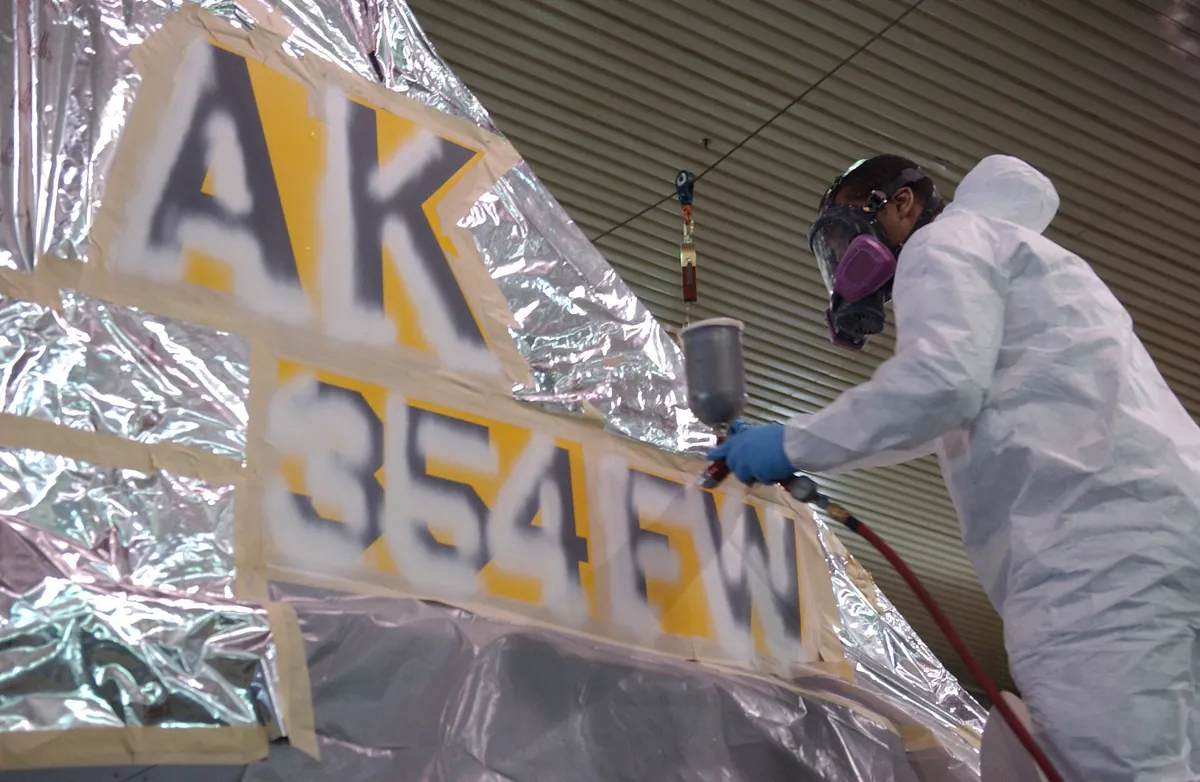
- Air. Use it only with adequate ventilation, and use explosion-proof ventilation equipment. When ventilation is not enough, wear a respirator, used under a respiratory protection program (fit testing, training).
- Eyes. Chemical splash goggles where spray or splash can reach you.
- Hands. Chemical-resistant, impervious gloves.
- Sparks and static. No flames, no smoking, no grinding or welding near the booth. Take precautions against static discharge.
- Allergies. Anyone with a history of skin sensitization should not work with it.
- Rags. See Clean Up. This is the one people forget.
Xylene, the thinner we use, is flammable too and has its own safety data sheet. Read both.
When You Can Spray
Check these before you open the can. They apply to the air, the steel and the paint itself. SW data sheet
- Between 40°F and 120°F. Steel stored outside or near a door can be colder than the shop air, so check the steel.
- Steel at least 5°F above the dew point. Closer than that and moisture forms on the steel under the paint.
- Relative humidity 85% or less.
Prep the Steel
Paint is only as good as what is under it. Sherwin-Williams’ minimum for steel: SW data sheet

- Get the oil and grease off first with solvent cleaning (SSPC-SP1). Cutting oil, layout fluid and fingerprints count.
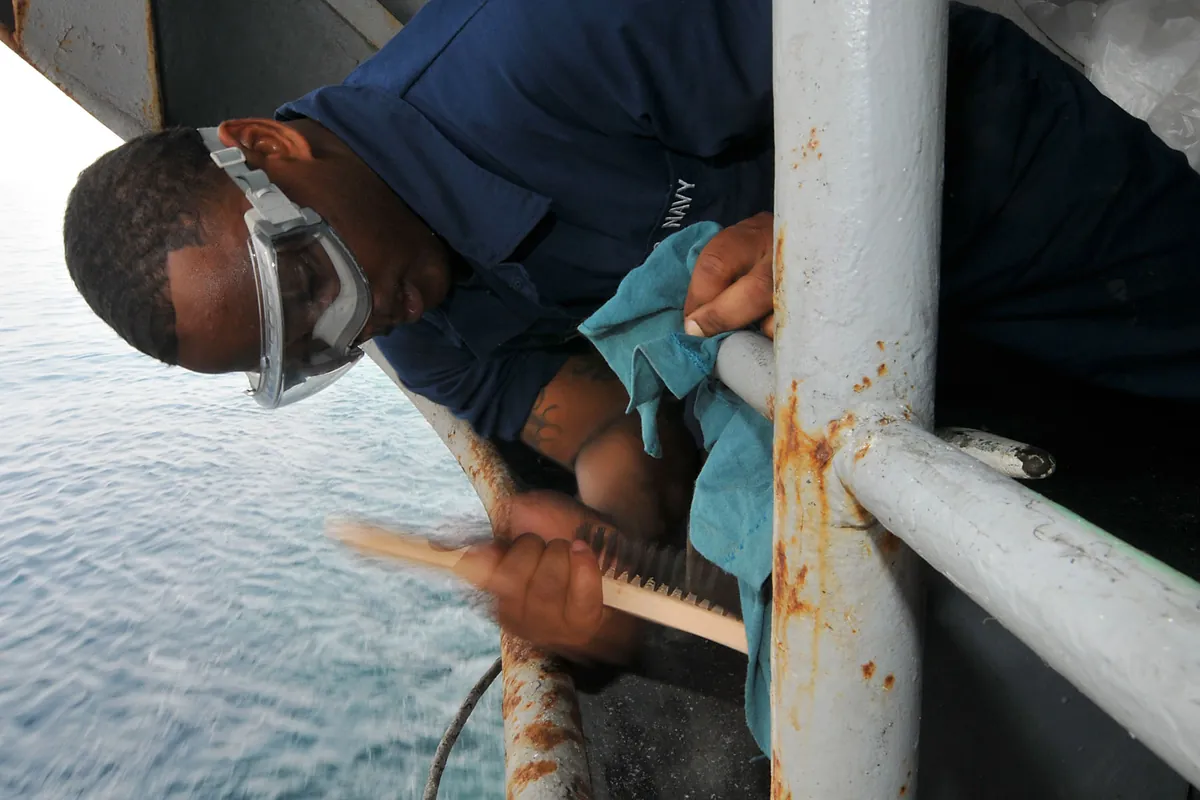
- Clean off loose rust, loose mill scale and old loose paint with hand tools at the least (SSPC-SP2).
- Blast if you can. SW says commercial blast cleaning (SSPC-SP6) gives better performance, with a sharp, angular abrasive for about a 2 mil profile.
- Prime bare steel within 8 hours, or before flash rust shows up, whichever comes first.
Primer. On steel, SW lists one coat of Kem Bond HS or Kem Kromik Universal Metal Primer, then two coats of Industrial Enamel. On galvanized steel and aluminum, it lists DTM Wash Primer under the two coats. SW data sheet
Our finish and material selection guide explains the prep levels and when paint is the right finish in the first place.
Mix It
- If the paint was tinted, shake it. SW calls for at least 5 minutes on a mechanical shaker to fully mix the color. The paint counter does this when they tint it. If it has sat on the shelf since, stir it well. SW data sheet
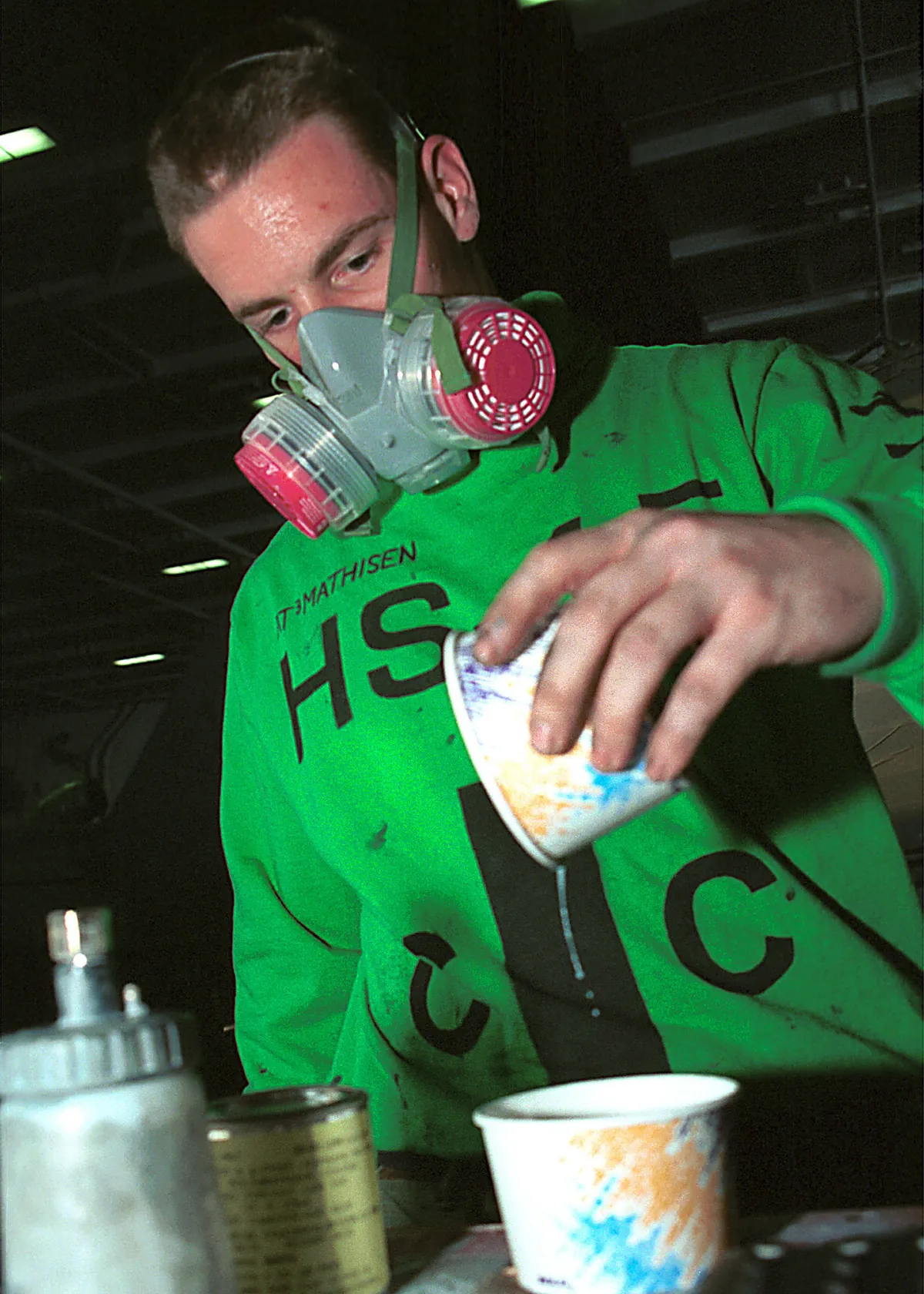
- Power-stir before you use it. Mix to an even consistency with a slow-speed drill mixer. Slow, so you are not whipping air into it. Scrape the bottom: pigment settles. SW data sheet
- Check the color on a scrap or a hidden spot before you paint the whole job.
That is the whole mix. There is no part B.
Thin It for HVLP
What Sherwin-Williams says
Both B54 data sheets say reducer: not recommended, for airless and for conventional spray. The low-VOC version adds that thinning can affect film build, appearance and adhesion. Thinning also adds solvent, so what you spray carries more VOC than the can. SW does not publish an HVLP setup for this enamel at all. SW data sheet
What we do
With our HVLP guns, it does not spray well straight from the can. So we thin it, about 10% xylene by volume. TCB shop practice
| Paint | Xylene (10%) |
|---|---|
| 1 pint (16 oz) | 1.6 oz |
| 1 quart (32 oz) | 3.2 oz |
| 1 gallon (128 oz) | 12.8 oz |
- Measure it. “A splash” changes from painter to painter. Use a graduated mixing cup.
- Add the xylene, then stir it in before it goes in the gun cup.
- Start at 10% and stop there if the gun lays it down smooth. More thinner is not better: thinner paint runs sooner and puts less paint on the part.
- Mix only what you will spray soon, and keep the can closed.
Why xylene and not acetone
A thinner has two jobs. It has to leave fast enough that the paint does not sag, and slowly enough that the paint can level out and stick. SW data sheet Here is how the three thinners people reach for compare, from Sherwin-Williams’ solvents guide:
| Thinner (SW number) | Minutes to 90% evaporated | Flash point | What SW says |
|---|---|---|---|
| Mineral spirits (R1K4) | 50 | 105°F | Weak, slow evaporating. Used mostly in alkyds. |
| Xylene (R2K4) | 11 | 80°F | Medium-fast evaporating, for epoxies and alkyds. |
| Acetone (R6K9) | 1 | 1°F | Too fast evaporating for most products. Extremely flammable. |
Acetone is gone in about a minute, so the paint starts drying in the air between the gun and the part and lands rough and dry. Its 1°F flash point also makes the booth more dangerous. Mineral spirits works in alkyds but is slow, so the paint stays wet longer and is more likely to sag. Xylene sits in between, and it is the reducer SW names on the data sheets for Kem Bond HS and Kem Kromik, the primers that go under this enamel. SW data sheet
Spray It
Set the gun up on scrap first, then paint the part. Below: how we set up our gun, how to hold it, and how thick to put it on.
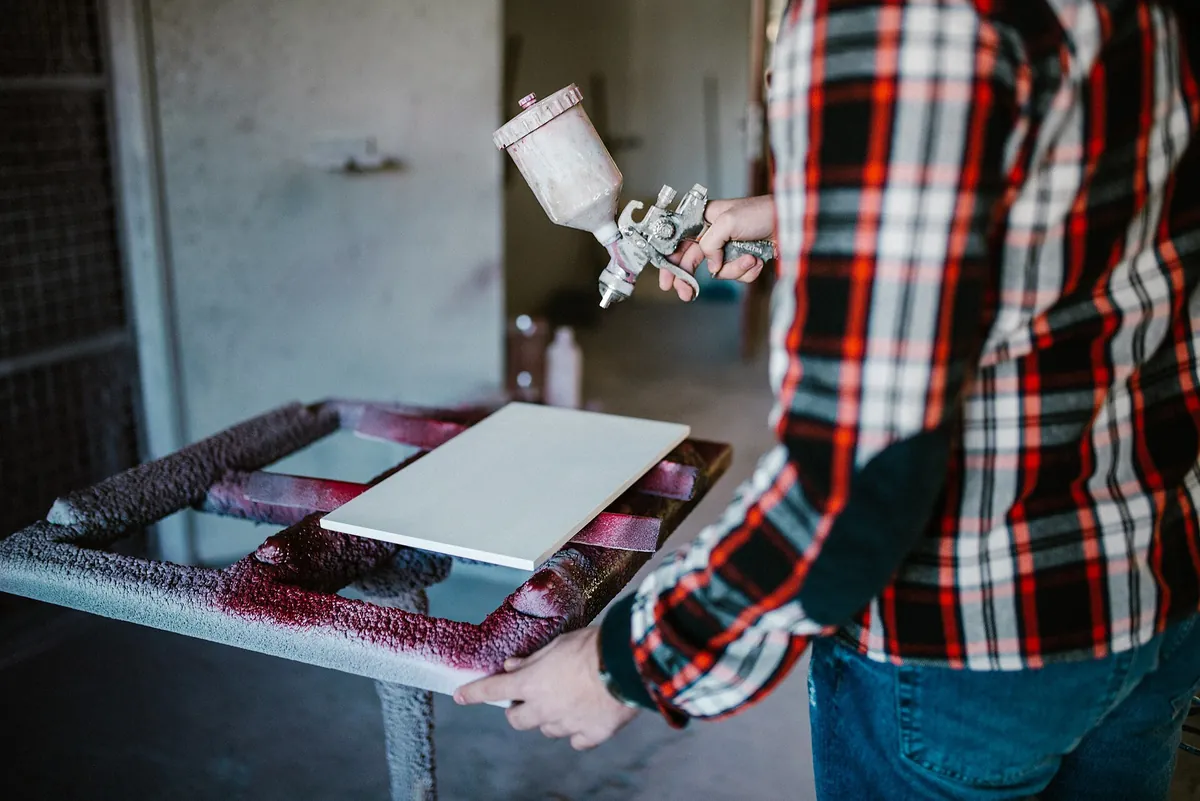
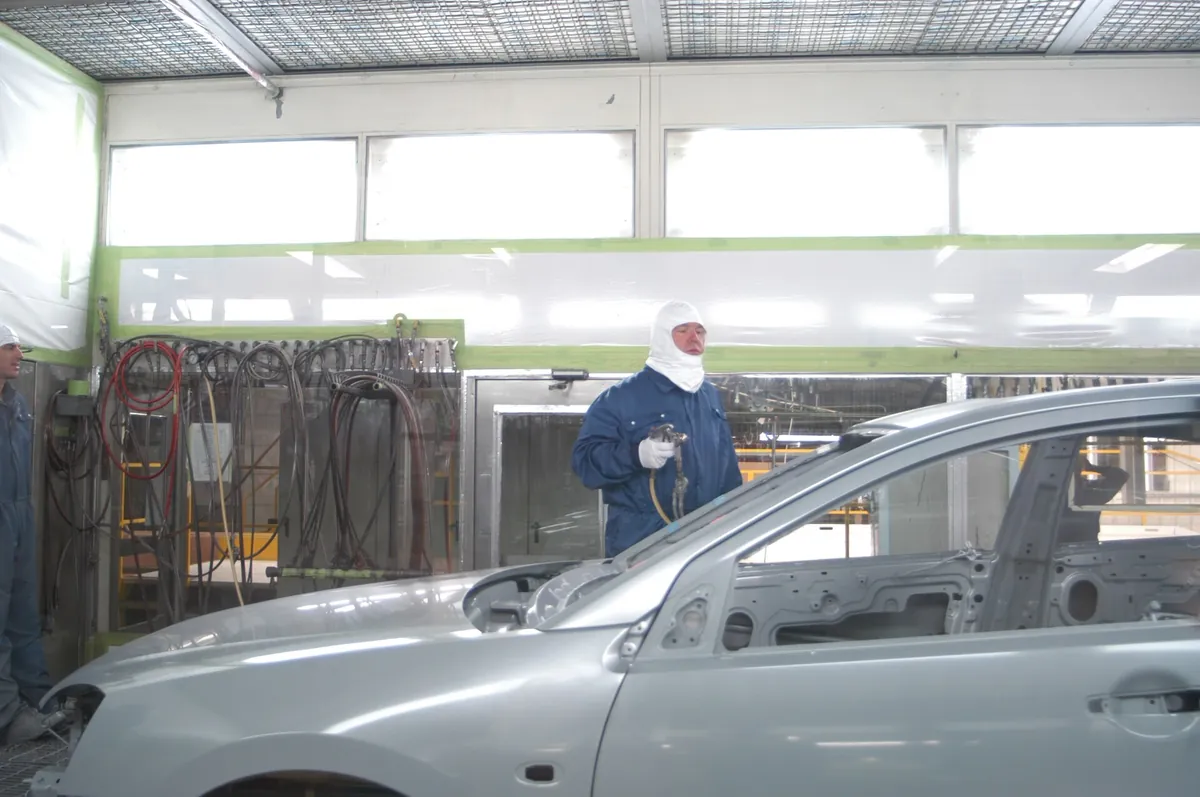
Setting up the purple Harbor Freight gun
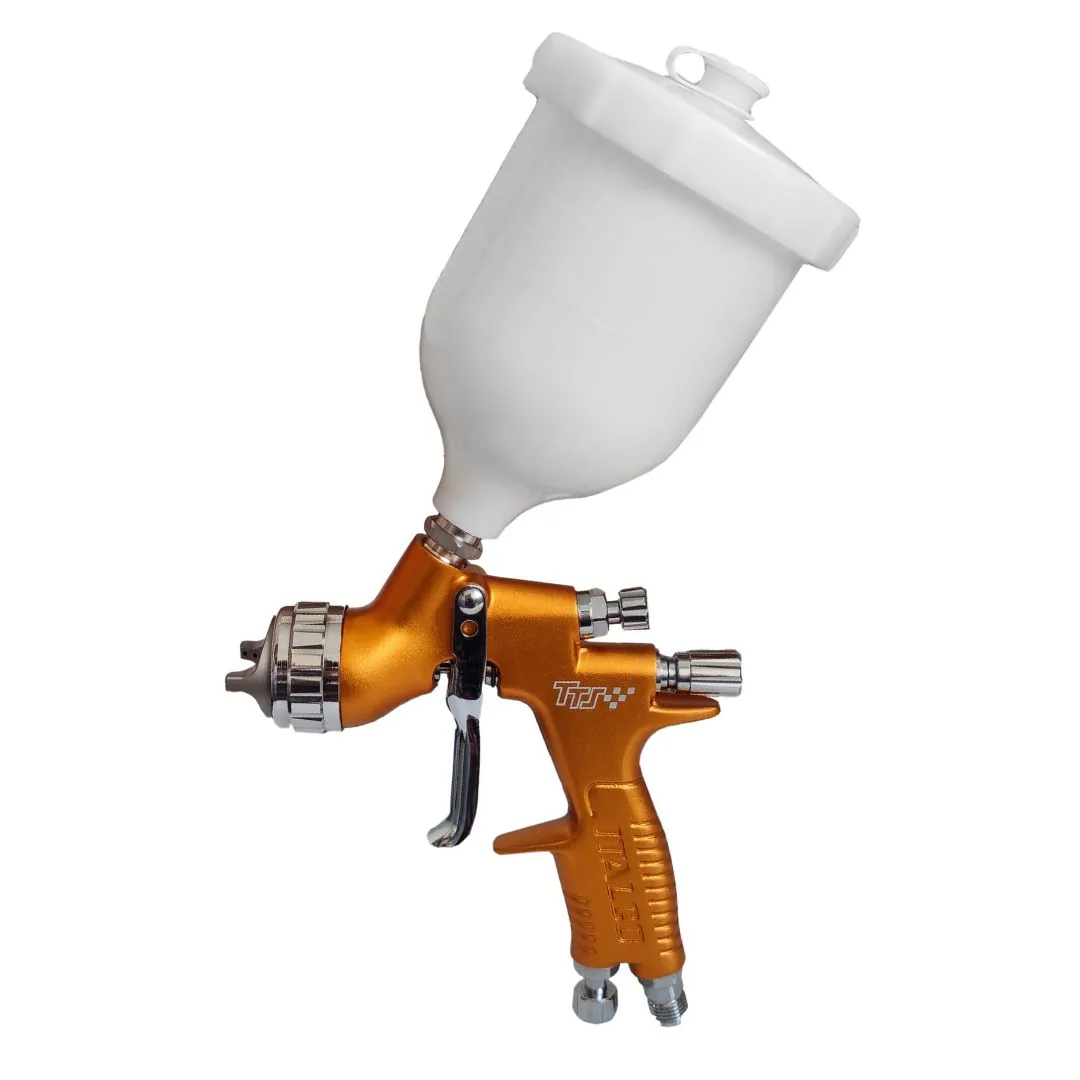
We spray with the purple Central Pneumatic 20 oz HVLP gravity-feed gun from Harbor Freight. TCB shop practice Sherwin-Williams publishes no HVLP setup for this enamel, so the setup below comes from Harbor Freight’s manuals. Harbor Freight has sold three versions, and their air ratings are not the same. Check the item number on your gun or receipt:
| Harbor Freight item | How to tell | Air pressure (manual) | Air use (manual) |
|---|---|---|---|
| 62300 | No gauge on the gun | 20 to 70 psi, 70 max | 6 CFM at 40 psi |
| 62381 | Gauge and regulator on the gun | 15 to 45 psi, 45 max | 12 CFM at 45 psi |
| 56982 | Newest; regulator sold separately | 14 to 45 psi, 45 max; HVLP at 29 psi in | Air use not listed |
Why it needs thinning. All three come with a 1.4 mm tip. Harbor Freight’s own tip chart puts “standard lacquers and enamels” at 1.5 to 1.8 mm, so straight from the can, enamel is on the thick side for this tip. Harbor Freight manual That is why we thin it about 10% (see Thin It for HVLP). The manual says to thin cautiously, a little at a time, following the paint maker’s directions. Sherwin-Williams’ direction is not to thin at all, so the 10% is our call, not theirs. TCB shop practice
- Strain the paint into the cup through a paint strainer or cheesecloth, and fill the cup 3/4 full. Harbor Freight manual
- Open the fluid knob until 3 or 4 threads show. Harbor Freight manual
- Set the air at the gun, with the trigger pulled all the way and the air knob fully open. A gauge at the gun reads what the gun really gets; the compressor gauge does not. Never go over your gun’s maximum. Harbor Freight rates item 56982 as true HVLP (under 10 psi at the air cap) at 29 psi going in. Harbor Freight manual
- Set the pattern. Pattern knob all the way open gives a flat fan; closed gives a round spot. To turn the fan from sideways to up-and-down, loosen the lock ring and turn the nozzle a quarter turn. Harbor Freight manual
- Test on scrap before you touch the part. Adjust fluid and air until the fan is even, with no heavy middle and no spitting. Harbor Freight manual
How to hold it
- Gun square to the part, about 6 to 9 inches away. Move your arm, not your wrist. Swinging the gun in an arc lays paint heavy in the middle and thin at the ends. Harbor Freight manual
- Start moving before you pull the trigger, and let go of the trigger before you stop. If the gun stops while spraying, paint builds up and runs. Harbor Freight manual
- Two thin coats beat one thick one. Harbor Freight manual
- Keep the compressor at least 25 feet away, in another room if you can. Harbor Freight manual
- Clean the gun right after every use. Harbor Freight warns that late or poor cleaning clogs it for good. Harbor Freight manual
For reference, these are the setups Sherwin-Williams does publish: SW data sheet
| Airless | Conventional | |
|---|---|---|
| Pressure | 2500 psi | 50 psi atomizing air, 20 to 25 psi fluid |
| Tip or nozzle | .015 in tip | Binks 95 gun, 66 fluid nozzle, 63PB air nozzle |
| Other | 1/4 in hose, 100 mesh filter | |
| Thinning | Not recommended | Not recommended |
Laying it down
- Stripe coat first. Brush or spray an extra pass along welds, crevices, corners and sharp edges. Paint pulls thin on edges, and SW says that is where it fails first. SW data sheet
- Overlap each pass 50%. Each pass covers half of the one before. That avoids bare spots, thin stripes and pinholes. SW data sheet
- Cross-coat if you need to. A second set of passes at a right angle to the first. SW data sheet
- Two coats. All of SW’s systems for steel call for two coats of enamel over the primer. SW data sheet
How thick
SW’s target is 1.9 to 3.9 dry mils per coat, which is 4.5 to 9.0 wet mils of unthinned paint, covering about 176 to 362 square feet per gallon. SW data sheet Check it with a wet film gauge as you go: press it into the fresh paint and read the last tooth that is wet.
Thinned paint has to go on a little wetter to dry to the same thickness. With 10% xylene, the solids drop from 43% to about 39% (43 ÷ 1.10), so the same dry film takes about 4.9 to 10.0 wet mils (1.9 ÷ 0.391 and 3.9 ÷ 0.391). That is our arithmetic on SW’s numbers. TCB shop practice
Dry, Recoat and Cure
| 50°F | 77°F | 110°F | |
|---|---|---|---|
| To touch | 3 hours | 1 to 3 hours | 30 minutes |
| Tack free | 8 hours | 4 to 6 hours | 4 hours |
| To recoat | 12 hours | 8 hours | 3 hours |
| To cure | 7 days | 7 days | 3 days |
“To recoat” is the earliest time for the second coat. “To cure” is when it is fully hard. Handle and load parts gently until then. SW data sheet
Clean Up
- Clean the gun right away with a cleanup solvent that is allowed where you are, then flush the spray equipment with it so the gun does not rust inside. SW data sheet
- Rags can catch fire by themselves. Sherwin-Williams warns that rags, steel wool, other waste soaked with this enamel, and sanding dust can catch fire on their own if they are not disposed of properly. Put them right away into a sealed, water-filled, metal container, and get rid of them under your local fire rules. Never leave a pile of rags on the bench or in a trash can. SW data sheet
- Close the cans tight and store them away from heat and sparks.
Check Yourself
Answer each question in your head, then tap it to check.
1. Does Industrial Enamel take a hardener?
No. It is a one-part alkyd enamel. Mixing means stirring it, and thinning it if you choose to. Nothing else goes in.
2. Your steel is 45°F and the dew point is 42°F. Can you spray?
No. The steel has to be at least 5°F above the dew point, so 47°F or warmer here. It is above the 40°F minimum, but too close to the dew point, so moisture can form under the paint.
3. Which thinner do we use, and why not acetone?
Xylene. Sherwin-Williams lists it for alkyds and it evaporates at a medium-fast rate. Acetone flashes off in about a minute, which SW calls too fast for most products, and its flash point is 1°F.
4. How much xylene goes in a quart?
About 3.2 oz, which is 10% by volume. A gallon takes about 12.8 oz.
5. Where do you read the air pressure on the gun?
At the gun, with the trigger pulled all the way and the air knob fully open, and never over the gun’s maximum: 45 psi on the purple 62381 and 56982.
6. What do you spray before the flat areas?
A stripe coat on welds, crevices, corners and sharp edges. Paint pulls thin there, and that is where it fails first.
7. You finished the first coat at 1 p.m. and the shop is about 77°F. When can the second coat go on?
About 9 p.m. or later: SW gives 8 hours to recoat at 77°F. If the shop is closer to 50°F, wait 12 hours.
8. Where do the used rags go?
Into a sealed metal can filled with water. Alkyd-soaked rags can heat up and catch fire on their own.
Sources and Limits
Read from Sherwin-Williams documents on paintdocs.com on November 24, 2026:
- Industrial Enamel, Alkyd Gloss Enamel, B54-100 Series, product data sheet (06/2021).
- Pro Industrial Industrial Enamel Alkyd Gloss, B54-1100 Series, product data sheet (11/2023).
- Industrial Enamel V.O.C., B54-Z100 Series, product data sheet.
- Solvents, Protective & Marine Coatings product information 12.00 (revised July 19, 2017).
- Kem Bond HS and Kem Kromik Universal Metal Primer product data sheets.
- Industrial Enamel, Pure White, safety data sheet (B54W101, revised October 21, 2026).
And Harbor Freight’s owner’s manuals (manuals.harborfreight.com) for its 20 oz HVLP gravity-feed spray guns, items 62300, 62381 and 56982.
Limits. Sherwin-Williams marks this product for professional use only. The 10% xylene thinning and the wet film figures for thinned paint are our shop practice, not Sherwin-Williams instructions, and Sherwin-Williams recommends against thinning. The safety data sheet differs by color: get the one for the color you are spraying. If your shop is under an air permit or a local VOC rule, check it before you thin. TCB Metal Works is not affiliated with Sherwin-Williams or Harbor Freight. Product names belong to their owners.